
Modern Streetcar Facts
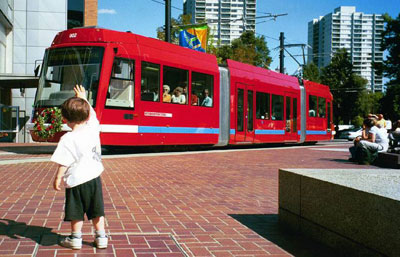 Included in the RTA plan is a Modern Streetcar line connecting University Medical Center, the University of Arizona, Fourth Avenue, Downtown, and the Westside with sleek, efficient, electric-powered rail vehicles operating 20 hours a day (5am-1am), seven days a week, every ten minutes from 6am-6pm.
While the Modern Streetcar only comprises about 4% of the overall RTA plan, it is garnering a lot of attention because of how important it is to our regional transportation future.
This is NOT a part-time historic trolley museum–this is a super-efficient, super-smooth, super-quiet full-time 21st-century mode of high-capacity rail transit for less than one-third of the cost of light rail.
You can view a 3-D animation of the Modern Streetcar as it will appear on Tucson streets in the upper right corner of this City of Tucson website.
Because the funded route is only four miles long, it is designed to extend its reach and work seamlessly with current SunTran bus routes and with the $450 million in additional bus improvements in the RTA plan to make the whole system work better for everyone.
The Modern Streetcar has already undergone a full federal study to prove its benefit to Tucson. 25 diverse community organizations–everyone from the Campbell-Grant Neighborhood Association to the Tucson Underground Contractors Association–unanimously endorsed the Modern Streetcar as the locally preferred alternative, as did the Tucson Mayor and Council.
Here’s just a few of the reasons the Modern Streetcar is a crucial element of our future transportation system:
* 10% of regional residents live or work within walking distance of the streetcar route.
* Congress has already passed a law earmarking up to $75 million to help pay for Tucson’s Modern Streetcar.
* The route is one of the most congested parts of the city where additional capacity cannot be added through additional road widenings.
* The population densities in this area are some of the highest in the city.
* Streetcars last three to four times longer than buses, carry more people per driver, and do not add wear and tear to the roadways, so over time a streetcar line is much cheaper than a bus line to build, operate, and maintain.
* The electric-powered streetcar can be fueled with solar energy, fuel cells, or other forms of green electric-generating technology. This protects us from future oil shocks, and creates no pollution on the route.
* A science-based study has determined that the Tucson streetcar will attract twice as many riders per mile than our most popular bus route.
* All costs, including operations and maintenance are already included up front; no additional funding will be necessary.
* Modern Streetcar systems are better than any other infrastructure investment at creating jobs and revitalizing street life in moribund downtowns. The Modern Streetcar line in Portland annually generates more new sales taxes from new retail along its route than it costs to operate & maintain the system.
* The streetcar is not intended to bring in long-distance commuters; it is intended to move people around the central city so they can park once, and ride the streetcar for their central-city trips; relieving congestion and pollution. The other transit improvements in the RTA will serve long-distance commuters more than adequately.
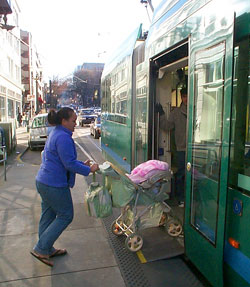 * Bikes and wheelchairs roll right on to the low-floor streetcars–no lifts are necessary, and it is so smooth that wheelchair tiedowns are also unnecessary.
* 50,000 students and staff go to and from the UofA campus each day, and the campus plan projects 75,000 at full buildout, with an intentional deficit of parking spaces to encourage people to use transit.
* 20,000 people work in the downtown area; Current downtown revitalization projects will increase dramatically that number as well as the number of people living Downtown right on the route.
* The route connects multiple parking garages all along its length, many of which are empty when there are events on the other side of the line–people could park at Downtown lots and take the streetcar to UA sports events or to the 4th Avenue Street Fair, etc. At night, once we get the Fox and other Rio Nuevo attractions open, people could park at UA lots, and take the streetcar downtown to cultural events.
* Connecting our revitalized Downtown and UA will create a synergy between the two that will be a powerhouse of education, culture, and economic development. It will be an axis of Cultural Creatives. It will make Tucson THE place to be for the high-tech, creative, cutting edge enterpreneurs and their endeavours.
* Encouraging higher-capacity transit through the streetcar will allow more people to live in the central city, reducing the pressure to sprawl into our Sonoran Desert environment, and reducing water use.
* People coming to our revitalized Downtown will find it enticing to explore the entire route; spreading the revitalization effect across to the east side of Downtown, up Fourth Avenue, Main Gate, and–in later extensions–up Campbell to Tucson Mall, down to the southside and the airport, and out to the east side. In a community with a heavy tourist trade, this is VERY significant.
When you look at the facts, our Modern Streetcar project is a great deal for all of us throughout the region. It’s yet another great reason to vote YES on Questions 1 and 2 on May 16.